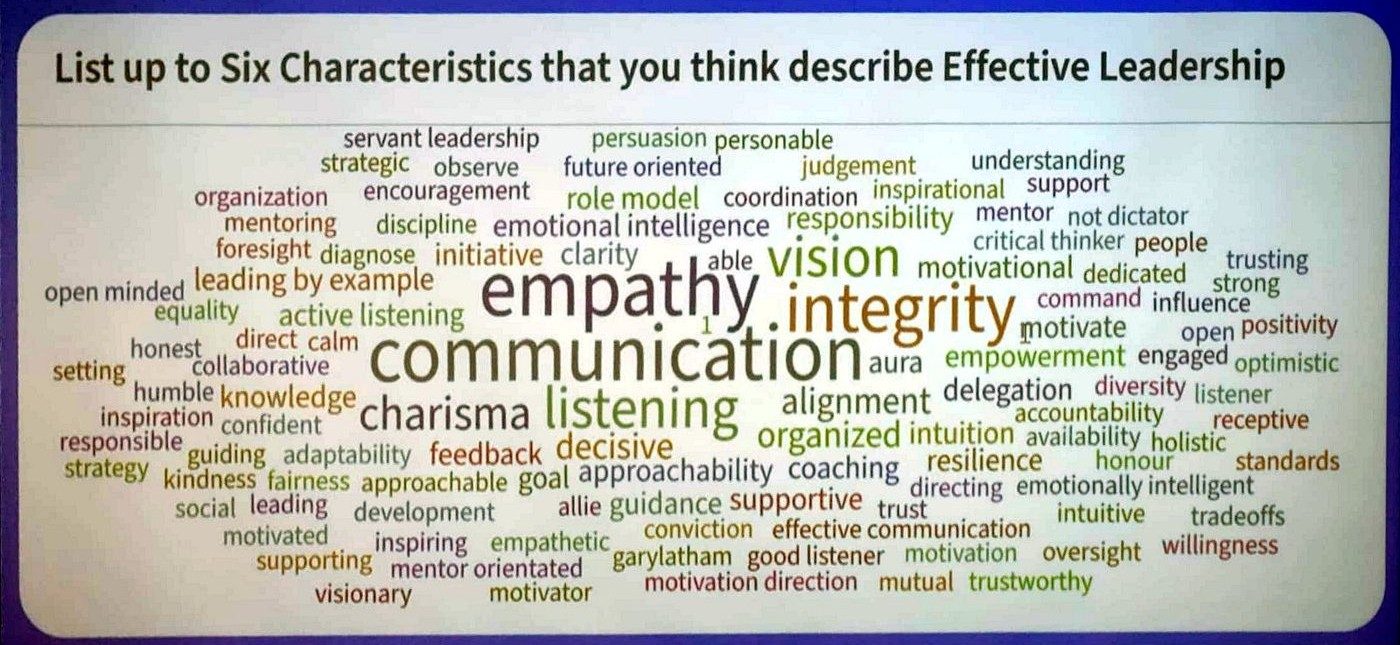
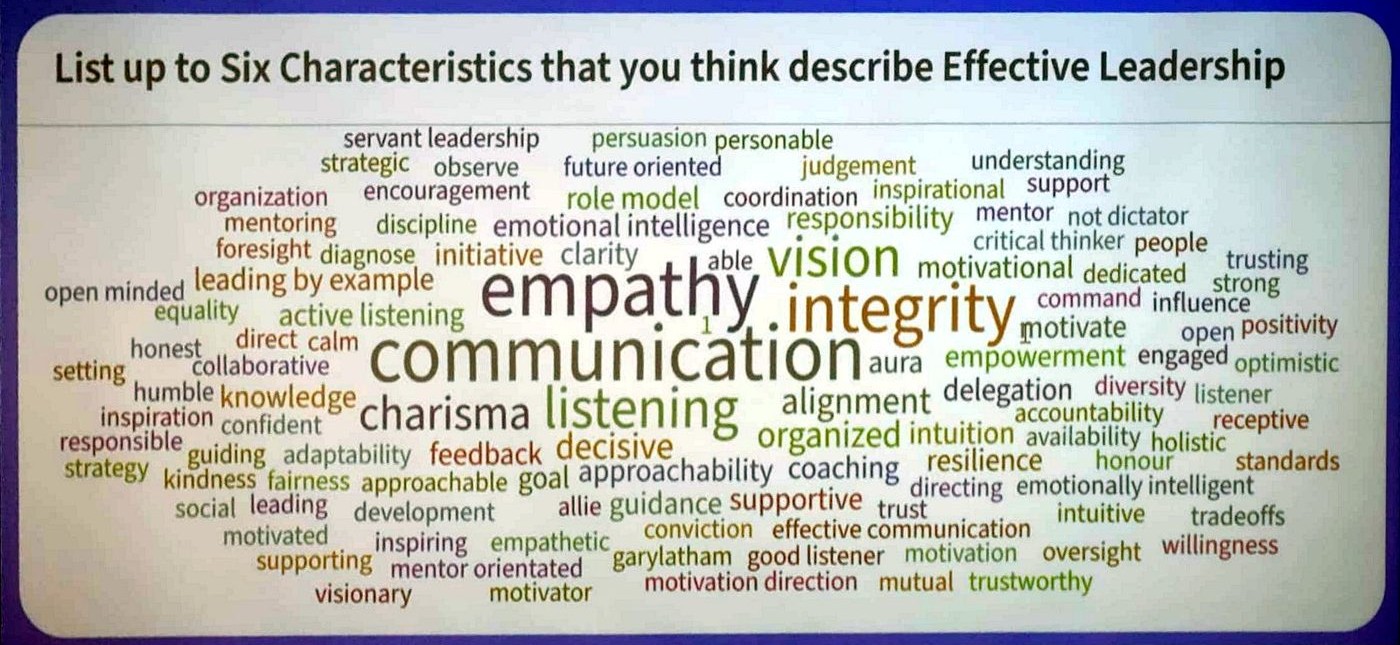
The class was asked to list up to six characteristics that describe effective leadership. These are all the distinct terms that came back. Each card compares those terms with the five basic conditions of teamwork from the Session 1 required reading.
Even the best leader on the planet can't make a team do well. All anyone can do is increase the likelihood that a team will be great by putting into place five conditions.Coutu (2009), interviewing J. Richard Hackman · reference 1
Traits against conditions
89of 111 describe a quality of the leader and match none of the five conditions
Hackman treats those qualities as necessary, so this is an incomplete answer rather than a wrong one: he credits emotional maturity as what lets a leader set a direction at all, and rules out any single prescribed style.
Each term was classified three times by an AI model working from the reading itself, each pass given a different framing brief. 101 of 111 came back unanimous and every term reached a majority. Method in full on the analysis page.
Terms per condition
The 111 answers against the five conditions
Conditions per the sidebar "How to Build a Team" in reference 1. The remaining 89 terms match none of them.
The shape of the response
3of 111 terms rendered largest on screen, meaning most people submitted them
82of 111 rendered at the base size instead, meaning one submission each. Three terms were submitted many times and most were submitted once.
Observe, diagnose, do
2of 111 carry any sense of observation or diagnosis
The course requires reading a team accurately before acting on it, and the class had almost no vocabulary for the reading part.
matched:
Two conditions with no terms
0terms for a real team, and 0 for a supportive organization
Nothing in the 111 refers to who is on the team and who is not, or to the reward, human resource and information systems around it. The class described leaders without a team or a supportive organization.
The missing deviant
0of 111 carry any sense of dissent, challenge or speaking up
Against Hackman in the same reading: "Every team needs a deviant, someone who can help the team by challenging the tendency to want too much homogeneity, which can stifle creativity and learning."
matched:
All 111 terms
One bar per term, ordered by the size it rendered at on the poll slide and alphabetically within each size. Bar length is that size, indexed so the largest is 100. Hover or tab to any term for the condition it maps to and the reasoning behind that.
Limitations. The photograph was taken at an angle, so the slide rendered as a trapezoid. Fitting the four edges puts the right side nearer the camera, with its edge 1268 pixels against 1078 on the left, a magnification of 1.18 across the slide. That is smaller than the narrowest gap between one size tier and the next, which is 1.39, so the distortion cannot move a word across a tier boundary. The photograph at the foot of this page has been corrected for it.
References
1. Coutu, D. (2009). Why teams don't work: An interview with J. Richard Hackman. Harvard Business Review, 87(5), 99–105.
Session 1 required reading. The five basic conditions and the deviant quotation are from the sidebar "How to Build a Team".
2. Hackman, J. R. (2002). Leading teams: Setting the stage for great performances. Boston, MA: Harvard Business School Press.
The book the five conditions in reference 1 are drawn from.
3. Leonardelli, G. (2026). RSM 2620 Leading Teams course syllabus, 2026–2027 Fall Intensive. Rotman School of Management, University of Toronto.course documentSource of the requirement to evaluate teams against the five basic conditions, and of the observe-diagnose-do model.
4. Leonardelli, G. (2026). List up to six characteristics that you think describe effective leadership [Poll Everywhere response cloud]. RSM 2620 Leading Teams, 29 August 2026. PollEv.com/geoleoprofessor's slidePrimary data, and the professor's own live poll slide. Every figure on this site is counted from the response cloud projected in class at 4:02pm.
The source. Every figure above is counted from this slide, photographed as projected in class at 4:02pm on 29 August 2026 and corrected for the camera angle. See the uncorrected original.professor's slide · reference 4